
Tag Archives: Learning

6000 visits and going strong
Carpe Diem !!!!
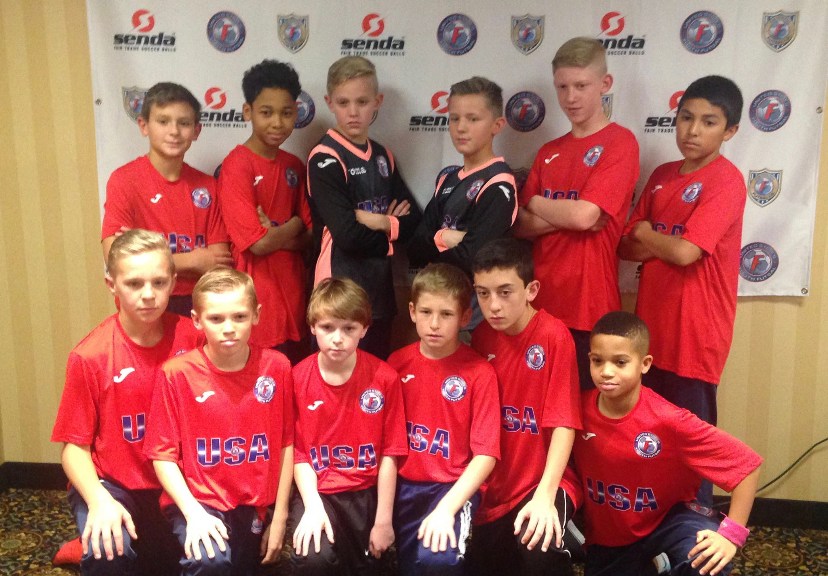
Futsal: impact on our boys
When it comes to football development, there is no silver bullet that works for every player. In general, developing an aptitude for anything in life requires some innate talent, repetitions, patience but most importantly a desire to hone the skill (grit). In our boys’ case, the desire to pursue football was always present from the onset; then, we just had to find creative ways to organically nurture that passion via variations of the beautiful game (futsal, indoor football, 3 vs 3, beach football, street football, football tennis, etc.). Today, we will briefly write about Futsal or (Fut)bol (Sal)a which is where the name comes from. Our boys practiced it (concurrently with “outdoor” football) for several years; it not only aided in their football development in a fun environment, but also provided a platform to compete at a high level at an early age. For parents with young kids interested in football, you may find this very useful. BTW, thank you US Youth Futsal and City Futsal.

Before I dive into the details, let me explain the picture above. In the picture, the U12 futsal players represented the US in 2015 at an international futsal tournament in Canada. In 2019 (and prior), over half of the players in the picture have also represented the US youth national setup at the 2004 or 2003 level. Coincidence? Maybe. Among some of those in the picture are: Evan Rotundo (Schalke 04 – Bundesliga), Kaïlé Auvray (Lille – French Ligue), Blake Pope (Charlotte – ECNL), Jeffrey Dewsnupp (RSL – MLS), Andrew Durkin (Atlanta United – MLS), Jogo (Louiville City FC – USL-C). There are others players but my mind draws blank at the moment. Talent attracts talent from an early age.
Here are some benefits of playing futsal
Year-round competition:
In the US, futsal is played mostly indoor on hard surfaces. This poses a great advantage over outdoor football because inclement weather is hardly a factor; thus futsal can be played year round or exclusively during football’s offseason increasing repetitions (practice time). Also, our country is so large that there are remote places where regular/competitive football leagues aren’t present or abundant, futsal could be an alternative as it only requires a basketball court, two goals made out of PVC and very few players. The video below shows the introduction to an international friendly futsal game played in Toronto, Canada in December of 2015 (outside temperature was 10 degrees Fahrenheit) with the participants from the picture above.
Small teams equates to more touches on the ball:
Other countries have futsal courts in schools and public parks. The US is not quite there yet. Futsal is played on small (mostly indoor) fields/courts with 5 players per team and unlimited subs. The smaller team size inevitably translates into more touches on the ball for all players involved (even the goalkeeper -GK-). In fact, the GK is one of the players who benefits the most as foot touches are increased and sometimes the GK just becomes another field player. Thus, the football development is magnified throughout its two fast-paced and intense halves.

Tighter spaces requires faster decision making:
The small courts require faster decision making by the players which translate really well onto outdoor football fields where players have more time to make a decision. Similarly, with smaller spaces, the precision of the passes has to be enhanced which is part of the reason for the heavier futsal ball.
Better ball control/distribution due to heavier ball:
Futsal uses a heavier ball which forces players (GK included) to have better control and distribution of it. Regulating the weight of the heavier ball requires repetitions. Futsal encourages touches with more parts of the foot than regular football. Also, since all field players are constantly moving up and down the court playing offense as well as defense, touches with different part of the foot are frequent. Specifically, touches with the bottom of the foot and the toes are encouraged. Let us be clear, there are fixed field positions in futsal; however, players tend to roam the entire court and in the process learning how to use both feet (strong and weak) equally. Last but not least, movement off the ball is a huge benefit learned at an early age. A player standing idle in the same spot for over 3 seconds is spotted easily.
Cleaner game encourages creativity:
Futsal is not a sport dominated by the strongest, tallest, fastest players; in fact, most of the time, our boys played with/against older players which magnified the need for quicker decision making and most importantly technical skill. Futsal games are normally very clean and easy to officiate. Teams are there to try to score as many goals as possible. Unlike regular outdoor football, futsal encourages creativity and flair. Players are able to express themselves incorporating tricks into their games styles w/out breaking any rules.

Rules are simple:
Although the rules in futsal are fewer than in outdoor (ex. no offside, throw-ins, etc.), players in futsal are constantly thinking about them (ex. ball on the line in a kick-in, delay of game, passing it back to the GK, etc.) and abiding by them which is not the case in outdoor football. Most outdoor football players just play the game especially at an early age. Mental agility and quick decision-making are aptitudes developed by futsal. These rules, far from making the game more complicated, make it more fun.
Fun:
Scoring goals is fun; it’s very typical to have futsal games where at least 5 goals are scored between the two teams. Not only that, the small courts make for many dramatic games decided in the last seconds of the match. High scoring games make it very enjoyable for the fans and the players involved. Ultimately, the players’ confidence is boosted by their ability to score or assist more often than outdoor football.
Confidence:
Futsal is a confidence booster. Here in the US, everyone starts off not knowing much about the sport but quickly learns the game. The earlier a player starts the better. Having a confident player is priceless; the confidence then permeates to other aspects of their lives including (but not limited to): the pitch, the classroom, and any other extra-curricular activities. Similarly, it’s very common for girls to play futsal with boys and that is also another confidence booster for girls.
One of the girls in the video below, grew up playing futsal, 3 vs 3, with Jogo. She now is (if not the best), one of the top three 2004 US YNT prospects and a candidate to play up in the upcoming U17 Women’s WC.
Unisex and friendships:
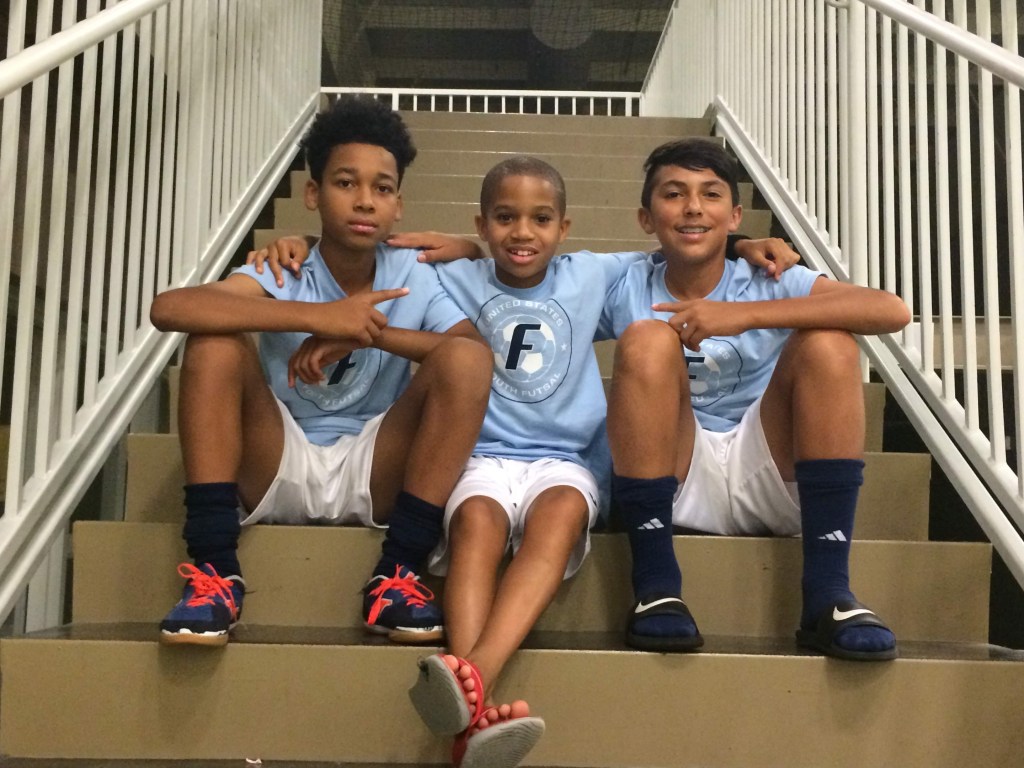
Unlike regular football, futsal leagues are very much unisex especially at the younger ages. The friendship bonds both of they boys formed playing futsal have helped them become better players. They continue to push each other all the time as some of them pursue a professional path. Jogo does a good job at staying in touch with most futsal players especially those he often sees at YNT camps. Three amigos pictured below:
Inexpensive sport:
In other countries, futsal is free to play as the courts abound in public parks. In the US, it’s not free but it’s not crazy expensive. For starters, there’s no one year commitment, and the uniforms are dirt cheap. If you can, join the local league or play youth pick up futsal games as often as possible. In our case, we would help the boys either join an existing team(s) and/or form a team to join the summer and winter leagues. This activity resulted in additional exposure which ultimately led them to be scouted for international competition.
National and international tournament/friendlies
Futsal is a FIFA (football world governing body) sanctioned sport. As such, it has different levels of competitions. In our case, both of the boys started at the local futsal place and worked their way to represent the US in multiple competitions around the world. Futsal provided a platform to see places and compete against traditional futsal countries in North, South, Central America and Europe.
Here are some disadvantages of playing futsal
Ignorance:
Some old-school football clubs/coaches do not support it. Some may even see it as a hindrance to football. In some cases, ignorance plays a role as it’s not a popular sport in some countries (US mostly). In other cases, the fear is driven by just having an alternative to football development. The now defunct DA league supported it, they started understanding its value and incorporated at least one futsal showcase tournament per year. Unfortunately, we honestly doubt that the new MLS youth league will continue that tradition.
Bad habits:
There’s a school of thought that believes that the longer futsal players stick with that sport, the harder the transition to football will be. There’s no data to support that hypothesis. However, it’s true that while playing futsal, some aspects of the outdoor game are neglected/not practiced: throw-ins, headers, free-kicks, offsides, positioning, etc. As a result, we recommend that both sports be played concurrently until it’s no longer feasible.
In the video below, you will see Rodrygo Goes (Real Madrid first team player and Brazilian sensation) doing some drills before his Santos FC futsal team faced a City Futsal all-star team that included Johan in Dallas. That game was played on June 29, 2014. In Rodrygo’s case, futsal definitely didn’t hinder his development. Futsal is popular in many countries like Brazil where players like Ronaldinho, Neymar, among others practiced it without compromising their ability to play regular football.


Understanding GRIT in an athlete’s life
I was recently invited to take part in one of our youth national team coaches’ new projects. As I was exploring their material, I stumbled upon this post. The blog publication attempts to explain grit/mental toughness and how to develop it. In essence, if you want to increase your chances of success in life -including sports- one has to develop a growth mindset. The earlier one adopts that type of mentality (ex. mamba), the less reliance is placed on factors that are outside of one’s control (ex. innate talent).

Wikipedia defines grit as “a positive, non-cognitive trait based on an individual’s perseverance of effort combined with the passion for a particular long-term goal or end state (a powerful motivation to achieve an objective)“. Please spend a few minutes listening to psychologist Angela Duckworth define grit in the Ted talk below. Then, try to relate it to your own situation (or your young player’s)
If you don’t have an additional ten minutes to read the blog above, here is a quick summary:
Define what grit/mental toughness means to you
We all have different goals and objectives in life. Make sure yours are SMART. Specific, Measurable, Achievable, Relevant, and Time bound. First, capture your SMART goals by writing them down. Next, start working on them; sometimes sharing them with others will elevate your own accountability level and will help you measure progress. It’s normal for young athletes to require assistance articulating their own goals. Once they reach certain age (or maturity) complete autonomy is expected.
As an example, during these times of no team practices. Our children have found creative ways to train most days. In addition to their physical training, one of the boys supplements his training by running about 5 kilometers/day at least 5 days per week. Each run should be done in the same course as the previous run as the completion time must be better than all the previous occurrences. This is part of a bigger goal he has.
Build grit in discrete portions
Grit does not have to be necessarily developed against extreme adversity. In fact, it’s best if it isn’t. Start by growing grit in your terms. Aim small miss small. In your daily lives, push yourself out of your comfort zone doing something simple or small that directly impacts your SMART goals/objectives. Faster growth occurs when we are outside of our comfort zones.
Develop a growth mindset by getting used to challenging yourself. Something as easy as going to sleep 15 minutes earlier because your goal is to sleep 42 hours/week. Understand that grit and mental toughness are traits that need to be carefully nourished. In the end, it’s all about developing and then maintaining the habits. The habit of continuous improvement equates to a growth mindset.
On a personal note, 7 years ago, when the idea about this family website was presented to us by my younger sister, I found many reasons to postpone its inception (mostly lack of time or so I thought). She insisted that we had so much to share with others and that it’s the least that we could do. Long story short, she’s no longer with us but we ended up following her advice. Thankfully, last year, we finally decided to push ourselves outside of our comfort zones and started this site in a non-native language. Now, we can’t stop writing and helping others. It’s become a self-rewarding family project that has impacted other families. We are constantly inundated with communication (texts, emails, and calls) from parents asking us for footballing advice. Also, we now see other families starting similar online (Twitter, YouTube) family projects as a result of our initiative: #theGomezway. The seed has been planted, now, it’s time to “pay it forward”.
Build strong habits and don’t depend on motivation
Grit and mental toughness are more about cultivating the needed habits to reach your goals. Developing consistency eliminates the need for sporadic motivation or courage (ex. going to the gym). If you create the correct habits to go to the gym, you will never need additional motivation (ex. a partner to work out with). Strong habits (especially an open growth mindset) are the basis for future success especially in athletes.
During these down times, the boys have been working everyday on some of their improvement areas. They work out and push each other hard, but fortunately, they do not depend on each other’s company for continuous improvement. They know they will be together for a short period of time and after they return to their respective new homes, their objectives will remain the same.
Recently, one of Johan’s Chumchat’s guests Will Swinney (Dabo Swinney’s son) summarized it best when he said:
Your thoughts become your words; your words become your actions; your actions become your habits; your habits become your character and your character becomes your destiny
Will Swinney
In closing, learn how to have a growth mindset. This is ONE way to develop grit or mental toughness. It all starts with the way we perceive the world. Have you ever wonder how listening to a single song has the power to change our mood? Our minds are very powerful. Make “continuous change” the norm in your daily lives and take control (or at least influence) of your success now.
BTW, this week’s chumchat video didn’t have any guests but the boys had a good time “reviewing” previous guests Instagrams accounts. It’s a funny episode. Give it a listen.
 #TheGomezway