Tag Archives: World Cup

What is Football Video Support (FVS)?

FVS is a simplified, lower-cost video-review system designed to give referees a way to review “clear and obvious” match-deciding incidents without the full technical, staffing and camera requirements of a traditional VAR center. It is not VAR with a different name — it’s a different operating model intended mostly for competitions that can’t run full VAR.

Why FIFA introduced it
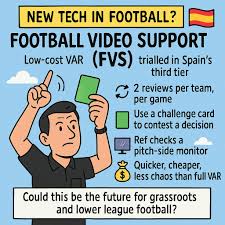
  • Accessibility and cost: many member associations asked for a more affordable way to use video to support referees (fewer cameras, no permanent VAR room and a smaller support footprint). FIFA developed FVS to meet that demand.
  • Control and simplicity: FVS aims to keep the referee at the center of the decision and to provide a framed, limited review process that’s easier to deploy across youth tournaments and lower-budget leagues.

When FVS is (and has been) used
While FVS was initially tested in the Spanish Futsal League (Primera División de Futsal), the first top-flight domestic association football league to fully adopt and debut the system was Spain’s top women’s league, Liga F (also known as the Liga Profesional de Fútbol Femenino) in the beginning of its 2025-2026 season (specifically, in September 2025). Prior to that, FIFA trialed and used FVS at multiple youth tournaments:

  • Blue Stars / FIFA Youth Cup (trial).
  • FIFA U-20 Women’s World Cup (trial in Colombia 2024).
  • FIFA U-17 Women’s World Cup (used in 2024 tournament and being included in subsequent youth tournaments).
  • More recently it has been used at FIFA U-20 (Chile) and U17 (Morocco) youth tournaments and trialed broadly.
What FVS reviews (which incidents can be challenged)

FVS is limited to the same four review categories normally associated with VAR protocols:

  1. Goal/no-goal (including offences in the build up, offside where applicable, handball).
  2. Penalty/no-penalty.
  3. Direct red card incidents (serious foul play, violent conduct, DOGSO, etc.).
  4. Mistaken identity when a referee books/sends off the wrong player.

How FVS works (step-by-step, matchday)

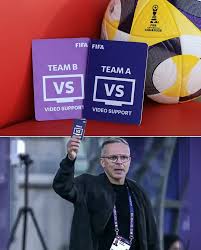
  1. Challenge method: unlike VAR, reviews are initiated by the coaches — each coach gets a limited number of challenge requests (typically two per match; one extra in extra time in competitions that allow it). The coach must hand a challenge card to the fourth official immediately after the incident to trigger a review.
  2. Referee review: the referee goes to a pitch-side monitor (or another on-field review area) to view replays provided by a replay operator using available broadcast/camera feeds, then makes the final decision. There is no separate VAR team continuously monitoring all incidents from a remote control room.
  3. Technology footprint: FVS is intentionally lighter — it generally relies on broadcast camera feeds or a small number of dedicated cameras and a local replay operator rather than a fully equipped VAR control room with many specialist cameras and staff.

Key differences vs VAR (at a glance)
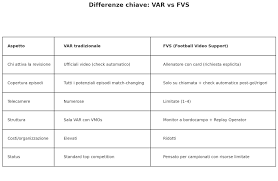
  • Initiation: VAR can perform “silent checks” and proactively monitor incidents; FVS only reviews when a coach requests a review (challenge).
  • Staffing/tech: VAR requires a full VAR room, specialist VARs and often many dedicated cameras. FVS needs fewer cameras, a replay operator and no continuous remote video-referee team.
  • Scope and coverage: VAR continuously watches all key incidents and can intervene; FVS is limited to coach-triggered, narrowly defined reviewable events. That reduces coverage and the chance of automatic correction.
  • Final authority: in both systems the on-field referee has the final decision after viewing replays, but FVS places more emphasis on the referee doing the review themselves on the sideline rather than relying on a separate VAR team recommendation.

Advantages of FVS

  • Cost and accessibility — much cheaper to implement, so more competitions (youth, lower leagues, smaller federations) can use video support. That’s the main strategic advantage.
  • Simplicity — fewer moving parts, simpler procedures and less technical overhead make roll-out faster.
  • Empowers coaches — gives coaches a structured way to challenge decisions (adds a tactical and accountability element). Some coaches and organizers like that involvement.
  • Keeps referee central — the on-field referee reviews evidence directly, which supporters say preserves authority and transparency.

Disadvantages / risks compared with VAR

  • Limited coverage / accuracy — because FVS usually uses broadcast feeds and fewer cameras, very tight technical calls (e.g., marginal offsides requiring frame-by-frame multi-angle geometry) may be harder or impossible to resolve as precisely as with full VAR systems that use multiple dedicated cameras and calibrated offside technology.
  • Interruptions & tactical misuse — coach challenges stop play and can interrupt momentum; coaches may “game” their challenges (save them for late in the match or use them tactically). Some coaches and observers have raised this concern during trials.
  • Fewer proactive corrections — because FVS waits for a coach challenge, clear errors that nobody challenges (or situations where coaches don’t want to burn a challenge) can remain uncorrected — whereas VAR’s silent checks can catch incidents that the teams didn’t notice.
  • Consistency & pressure on referee — the on-field referee must perform the review and deliver the decision in front of teams/fans; that creates different psychological pressures versus VAR where a separate VAR team can make or strongly recommend the call remotely.

Early data & reception

Reports from tournaments and media indicate FVS is being used regularly in youth tournaments and early trials. Coverage from trials shows a modest number of reviews per game (e.g. some reporting cited an average around ~1.4 interventions per match in certain trials, with a large proportion confirming the original decision) — but opinions are mixed: some refereeing authorities and coaches welcome the lower cost and clarity; other stakeholders worry about interruptions and possible tactical use. FIFA and IFAB are monitoring trials and collecting data before deciding on wider roll-out.

Practical example (how a coach challenge looks in real time)

  1. Coaching staff thinks a referee missed a clear handball leading to a goal.
  2. Coaching staff immediately gives the fourth official the challenge card. (If the ball is in play again, the challenge must be given immediately — the Laws require that a decision be changed only before play restarts.)
  3. Referee stops play if necessary, views replays on the pitch-side monitor supplied by the replay operator (using available camera angles), then signals and announces the final decision to the teams and stadium.
Bottom line — when FVS makes sense

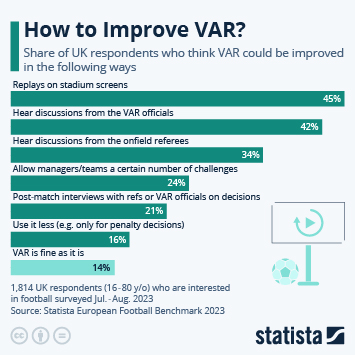
FVS is a pragmatic compromise: it’s not meant to replace VAR in elite competitions that can afford full VAR with advanced camera systems, but it does give many more competitions a practical path to use video review for big, match-deciding incidents. For youth tournaments and leagues with limited budgets it’s a realistic step forward; for top professional leagues the trade-offs in precision and continuous monitoring mean many will continue to prefer full VAR — at least until FVS matures or hybrid models appear. It is worth noting that if for whatever reason the FVS technology malfunctions, the match will continue without the system after both team managers and captains have been informed. As for VAR, there’s always room for improvement as depicted by a survey conducted in the UK.
If you would like us to break down any other football topics, please reach out at info@thegomezway.com

What’s up with the FIFA 2030 World Cup?

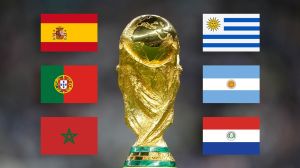
Last month, FIFA announced that the 2030 FIFA Men’s World Cup (WC), officially denominated as the centennial WC, will once again be jointly hosted by more than two countries. For the 24th edition of the quadrennial event, FIFA selected host nations which are scattered across multiple continents (3) and about 6000 miles apart. In a nutshell, the games will be played as follows:

  • Inaugural games (3) in Uruguay and one group game each in Argentina, and Paraguay
  • Rest of the games (101): Spain, Portugal, and Morocco

Below, we analyze, and hypothesize, as to the reasoning of such decision by FIFA.

Host nation requirements

FIFA is comprised of six confederations: Africa (AFO), Asia (AFC), Europe (UEFA), North America (CONCACAF), South America (CONMEBOL), and Oceania (OFO) whose member nations can submit bids to host a WC. FIFA has a list of requirements that a potential host nation need to have. Below is just a summary.

Infrastructure:

Unfortunately, only Argentina currently possesses one or two stadiums with the below requirements that FIFA could potentially approve. The three host countries do have a few stadiums that could be renovated by 2030 but that would cost money these nations do not have. Fortunately, they have over six years to attempt to be prepared and a governing body -FIFA- more than willing to bend their own requirements in exchange of some re-election votes.

  • Have at least 14 all-seater stadiums
  • Each of the 14 all-seater stadiums must have a capacity of 40,000 seats
  • 7 of the 14 stadiums must pre-exist prior to the bid submission
  • The opening and final match must take place in a 80,000-seat stadium
  • The semi-finals matches must take place in a 60,000-seat stadium
  • Have at least a pool of 72 suitable training sites for team base camps
  • Have four suitable venue-specific training site options per stadium
  • Have two suitable referee base camp training site options

In addition to the infrastructure requirements above, the FIFA council also enforces loosely documented requirements regarding broadcasting sites, competition-related event sites, as well as accommodation, requirements for sustainability, environmental protections, human rights, governmental support, and organizational model to be used. FIFA is used to turn a blind-eye on their documented requirements. Enforcing the host nation requirements resembles football refereeing a lot. It’s subject to interpretation…

FIFA’s confederation rotation policy

Along with the above requirements, FIFA has a policy of excluding from bid submission contention the confederation(s) where the most recent WC took place. At the time the selection of the 2030 WC was announced in October 2023, Qatar had hosted the 2022 WC; therefore, AFC was excluded. Also, since the 2026 WC was already scheduled to take place in Canada, Mexico and the United States, CONCACAF would also be excluded from bid submission contention. Therefore, the following confederations remained as viable candidates for the 2030 WC: AFO, UEFA, CONMEBOL, and OFO. It’s noteworthy that FIFA’s rotation policy has “somehow” historically excluded AFO (except for South Africa in 2010) so it was now time to pay favors to Africa. More specifically, Morocco had bid for a WC many times so it was long overdue.

Many speculate that with FIFA’s rotation system and the 2030 selection concluded, CONCACAF (which will host the 2026 WC), CONMEBOL, UEFA, and CAF (confederations due to host the 2030 WC), would be unable to bid for the 2034 WC, leaving the AFC and OFC as the sole candidates. This has led to accusations that FIFA selected the hosts only to ensure that Saudi Arabia, an AFC member with major human rights controversies (like Qatar in 2022) would have their bid uncontested. Since FIFA wants to make the 2034 decision in 2024, it would leave little time for other eligible members OFO (Australia and New Zealand) or China (AFC) to attempt to prepare a strong bid to co-host the 2034 WC along with Saudi Arabia.

Global reach

FIFA members will be the first ones to justify that awarding the 2030 WC to multiple nations across different continents will enhance the global appeal and reach of the tournament. Nothing can be further from the truth as the “beautiful game” is by far, the most popular and viewed sports event in the world. It really does not need any additional outreach to garner more appeal. In fact, one could argue that awarding the tournament to countries that lack the infrastructure to host the tournament is financially detrimental to the growth of the game. See attendance #’s in the “new” continents: Asia and Africa (lowest of the last 10 occurrences). South Africa is still recovering from the deep investment in WC infrastructure from 2010.

World CupTotal AttendanceAttendance/game
2018 – Russia3,031,76847,371
2014 – Brazil3,441,45053,772
2010 – South Africa3,167,98449,499
2006 – Germany3,367,00052,609
2002 – Japan/ S. Korea2,724,60442,571
1998 – France2,859,23444,676
1994 – USA3,568,56768,626
Attendance per WC.
Note: In 1998, the # of countries participating increased to 32

Political reasons

Like any of his predecessors whose career continuity depends on re-election, FIFA President Gianni Infantino is known to be a good populist diplomatic. Nothing can guarantee more votes from different continents than to spread the joy of hosting WC games among three unqualified countries: Argentina, Paraguay, and Uruguay. These three countries were allegedly selected as co-hosts nations to commemorate the 100th anniversary of the original WC in 1930 that took place in Uruguay.

Uruguay

The reason for Uruguay’s inclusion can be somewhat justified as the nation which hosted (and won) the first WC in 1930. Uruguay has qualified to 15 out a total 22 WC. It’s a regular attendee by its own merits. It has also won the WC twice in 1930 and 1950.

Argentina

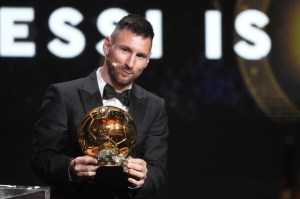
Argentina is the current men’s WC champion whose national team rosters probably the best footballer in history. It’s hard to exclude them especially since Argentina is a neighbor to Uruguay. In May 2023, FIFA President Gianni Infantino started hinting at a possible Argentinean favoritism when, for political reasons, FIFA stripped Indonesia the opportunity to host the U20 men’s WC and suddenly granted it to Argentina -whose team had failed to qualify in CONMEBOL. To magnify that perceived favoritism, many argued that Messi didn’t deserve the recently awarded 8th Ballon Do’r 2023 but was secretly favored in the votes due to winning the 2022 WC. Argentina has qualified to 19 WCs out a possible 22. It has won the WC three times in 1978, 1986, and 2022.

Paraguay

The original CONMEBOL bid to host the 2030 WC included Uruguay, Argentina, Paraguay and Chile. The only reason I can reason for the inclusion of Paraguay is to honor the original bid but if that were the reason, why exclude Chile? Other than that, I am unable to justify Paraguay’s inclusion; this country wouldn’t be able to host a WC on its own given its infrastructure so other than neighboring Uruguay and Argentina, this seems as a quid pro quo reason. Paraguay has qualified to 9 WCs out a possible 22 and has never won a WC. Don’t forget that host nations get an automatic invitation to the WC, this means that not only Argentina, but also Uruguay and Paraguay, are automagically qualified to the 2030 WC (another FIFA gift).

Economic reasons

Out of the three South American nations, no economy is hurting as much as the Argentinean. Read my post about my recent trip to Argentina. With the football infrastructure Argentina currently has, a new president, Javier Millei taking office in a few days and six and a half years to prepare, hopefully the country can benefit from an influx of tourists and the economy can recover (once and for all) from the recent lows the nation has experienced in the past ten years.

Be it what it may, we in the United States, will have an opportunity to travel a shorter distance to gelid South American countries during their winter to hopefully witness some familiar football faces who will start to shine in 2026 and may be consolidated by the 2030 WC. Until next time #theGomezway

First U20 World Cup game against Ecuador

Here is a quick recap of the game against Ecuador including my “commute” to San Juan, Argentina along with the usual pre and post-match behind the scenes stuff. Hopefully, some info and pics below are useful for future USYNT generations. Otherwise, if you are the casual reader, try to enjoy the content.

Trip

Dallas to Buenos Aires

My flight left Dallas Fort Worth (DFW) International airport at 9:20 PM on Thursday, May 18 (Match Day – 2). For an international trip, I normally like to leave at least three days before match day but it was impossible this time. It was a 10 hour direct flight to Buenos Aires; I arrived around 11:20 AM local time (2 hours ahead of Dallas). As we landed, my T-Mobile device took forever to receive a signal and I was beginning to panic. We rely so much on those mobiles and the trip to San Juan was going to be a long one without a working phone. As I made my way to customs, my phone service was restored. At last, panic mode was turned OFF.

Argentina is plagued with street murals like this one

Buenos Aires to San Luis

I quickly proceeded to the rental car counter (where I also exchanged currency -1 US dollar is approximately 460 pesos). By 12:30 PM, I was out of the airport driving to the province of San Juan. Due to the length of the trip (1118 Kms -~800 miles), it consisted of two parts. When I left, I honestly didn’t know how long the first leg was going to be…always love the adventure especially when I’m traveling by myself.

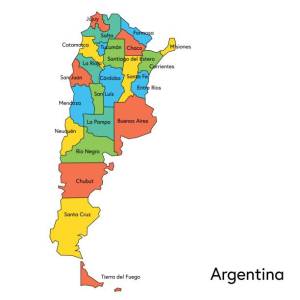
San Juan is about 14 hours away from Buenos Aires since 90% of the trip consists of one lane roads with very low speed limits (100 – 120 Km/hr). The first leg was a very dull drive of about 10 hours from Buenos Aires to San Luis (a different province/state) crossing 3 provinces (Buenos Aires, Cordoba, and San Luis) in the process. It rained (sometimes poured) for at least 8 out of the 10.5 trip hours. Leg two of the trip crossed two additional provinces (Mendoza and San Juan). FYI Argentina has 23 provinces/states.

Argentina’s 23 provinces/states

San Luis to San Juan

I spent the night in San Luis and the next morning, I left to San Juan around 6:15 AM for the last 3.5 hours of my trek. It was a bit of a treacherous drive as the first two hours were up in the cooler and foggy mountains, early in the morning (no coffee) and more one lane roads.

Game

As in any tournament, the most important game is the first one. The team knew it and they were mentally prepared for it. Ecuador is a solid team with excellent individual talent and speed at every position; however, they sometimes lack cohesion and discipline in the last third. To be fair, the roster they took to the South American qualifiers was a tad different than this group for the world cup. It was imperative that we won possession in the midlfield.

Pre-game

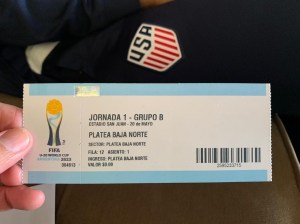
I arrived at San Juan’s AirBnb around 10:30 AM, took a quick shower and went straight to see Jogo at their hotel. It was 12:15 PM (game was at 3 PM) when I was picking up my ticket to the game from the front lobby and I used the opportunity to wish him well and possibly calm any nerves.

It was reassuring that he was perfectly mellow about his potential WC debut. He had known that he could be playing in a different role for a few days, practiced accordingly and was tactically ready.

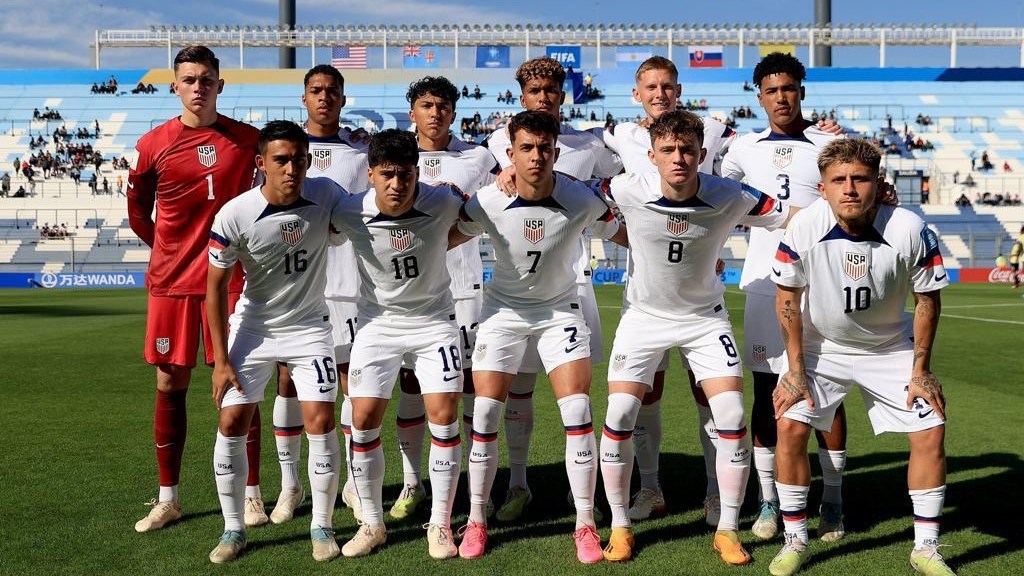
Obligatory pre-match pic

As I was leaving the hotel, I said farewell to a few of the players as they were making their way to the bus. It was very moving (and emotional for me) to see how the non-coaching staff one by one lined up from the hotel exit all the way to the bus entrance, to high-five and wish each team member a heart-felt, encouraging farewell. The majority of the non-coaching staff rides separately from the players and coaching staff. This was another sign of the family environment that Mikey has created with this team in his short term as the coach. As I made my way to the car, I was hesitant to return to the AirBnb to rest a bit fearing that I’d fall asleep through the game since I was so tired so I made my way to the stadium instead.

Staff wishing players and coaching staff the best of lucks outside the hotel

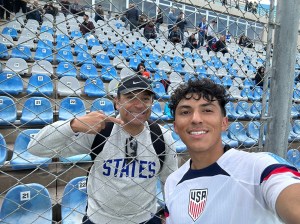
I arrived at the stadium where I sat in the US section. Our section was pretty much empty except for one additional player family, the rest of the non-coaching staff, and two players who could not participate in the first match. Given the excitement, I really didn’t take any pre-match pictures until after the match.

Most of the crowd arrived after the ceremonies

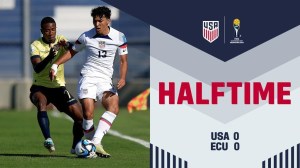
1st half

The beauty of this game is that we all can have a different view point and that’s okay; thus much analysis is not needed as most of you witnessed what transpired. I’ll venture to say that we dominated the first 20 minutes or so and then Ecuador settled in and finished the half stronger than we did. Jogo had a good challenge with Nilson Angulo (#10) and I am glad they faced each other for their own development needs. It won’t be the last time they face each other. Did you all catch #19? He’s a 2007 born!!!

2nd half

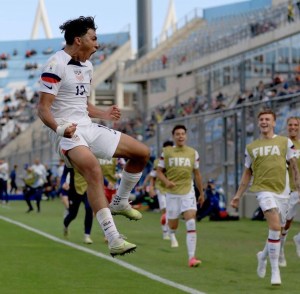
Ecuador played a better second half with the crowd behind them all the time; fortunately, they never presented a real threat to our GK. The temperature was not extremely high; however, the sunlight hits differently here in San Juan. Our boys seemed a bit tired and the Ecuadorian players, accustomed to that climate, had the momentum especially in the last quarter of the game. Our subs came in, adjusted well, provided a much needed energy spark and they certainly made a difference. At last, we had won the first game of the 2023 U20 WC.

Post-game

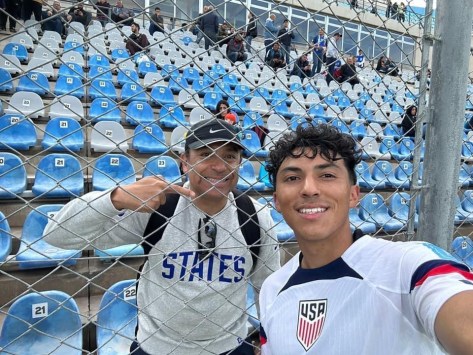
I only saw Jogo for a brief moment after the game. Ironically, when he tried to approach me near the sturdy fence separating fans from players, the same fans who were strongly rooting against the US throughout the game were the same ones trying to fetch a jersey, selfie or even an autograph from the US players. In the end, I was glad we did manage to snap this selfie below.

I stayed after our game to watch the double-header game between group rivals Fiji and Slovakia. It was good to scout the level of the competition our team will be facing today. On Friday, the second header game after our match with Slovakia will be sold out as Argentina will be playing against New Zealand. It should be a good one to watch.

It was a hostile environment where 95% of the 14k in attendance were naturally rooting for Ecuador. Our boys were mentally prepared and had an importantly good first showing; they know that the task at hand will should become more and more challenging.

As they continue their journey in this tournament, please remember that no matter what happens in the next games, these boys are giving their best for themselves, their teammates, their families, their communities, their clubs, you fans, and last but not least, their country. At the end of the day, this is a game, the beautiful game. Let’s keep it that way. The outcome of a football match (tournament) does not define us as individuals and much less as a country, nor should it define their careers. After each world cup game, Jogo will still be buddies with players from Ecuador, France, Slovakia, or whoever they play in the competition. As fans, we need to understand that there will be good games and not so good ones, that’s football and we can’t do anything to change that dynamic. However, how we react to their performance is within our control. Let’s not become the type of fans who use the outcome of a match as a justification for questionable behavior (ex. Valencia vs Real Madrid, El Salvador) physically or online. We owe it to the betterment of the game in this country to act responsibly.

That said, thank you for the tremendous outpouring of love and support received in the past couple of days. It will never be forgotten but we must keep a leveled head there as well. It was a great first win but there are far greater challenges lying ahead. Only few will probably know that, unfortunately, in this ephemeral, competitive profession, the good days are hard to come for a footballer. As I share that with you, please be sure to reach out to all US players (especially those abroad away from their families), when things may not be going well during their seasons. I’m sure they will appreciate hearing your unwavering support during challenging times as well. In the process, you will be contributing not only to their mental well-being but also to the betterment of the sport in this country. Every bit makes a difference in the life of a footballer. As you know, the summer will have a few important competitions for the USMNT; start reaching out to some of those players now if you can with words of encouragement.

As I wrap this post up, I’m heading to the second game against Fiji. They will feel your support from afar and the other two families and myself will do our best to permeate the good vibes onto the field. As always, thanks for reading. Let’s go boys!!! #theGomezway

PS Before I head into the stadium, I will stop by the Red Bull Skateboarding Tour Event taking place in San Juan, Argentina. This event is a qualifier for next year’s Olympics in Paris. Football does take you to unexpected places and events sometimes. I am so grateful to the sport…

Red Bull World Skateboarding Tour

PK shoot-out tips provided by YOUR coach

Two of the recently finished World Cup (WC) quarterfinal games reminded us that penalty kicks (PKs) shoot-outs are not the prettiest way to decide the outcome of a football match. PK shoot-outs are normally very dramatic, preceded by at least 120 minutes of intense (in most cases) action and some detractors tout them as the most unfair method to declare a match winner. Their argument is that the shoot-out relies heavily on luck rather than football skill. It has also been said that PKs are a dual effort instead of a collective team effort defeating the purpose of the team sport spirit.

“Luck is what happens when preparation meets opportunity” – Lucius Annaeus Seneca

Whatever your perception may be on overall luck and shoot-outs, a PK shoot-out is an approved method by FIFA laws to break a tie. Also, nobody can deny that being directly involved in the taking of even a single PK (more so a shoot-out) requires some level of technical preparation (sometimes years) and individual mental fortitude (aka nerve). Therefore, any edge that can be gained over the opponent to increase the chances of victory in a PK shoot-out is always welcome. Often neglected, that advantage can easily come from one’s bench. A coach’s experience is a very valuable tool if applied correctly and timely.

In the clip above LVG explains the selection of his PK takers prior to the WC

PK Shoot-out Preparation

I will not dwell too much on the pre-game efforts that the goal keeper (GK) coach, the team video analysis specialist, the team statistician, and the GKs themselves must undergo prior to embarking on a match that could be decided in a PK shoot-out. The preparation is not complex but indeed meticulous. It starts with trying to anticipate which five potential PK kickers will take a turn and study their PK kicking tendencies. On top of that, each GK has his/her own defensive diving tendencies to attempt to block PKs. Simply put, it comes down to video-analyzing the potential PK kickers to slightly increase the GK’s odds of stopping PKs.

Similarly, PK takers need to undergo a lengthier preparation which starts much earlier in their football careers than the upcoming game at hand. For example, in some youth leagues around the world, match ties are not allowed forcing PKs intentionally. Match outcomes are decided via a PK shoot-out with the underlying idea of developing better PK adult kickers who are not only more used to the added pressure but more technically sound in the art of PK taking via lots of repetitions. PK kickers rarely analyze GK tendencies as those diving techniques are reactive and situational.

All that pre-match preparation for PK kickers is indispensable and must be met at a minimum to be even considered as a genuine PK taker candidate especially at a world stage like a WC. However, there are meticulous decisions that must be made in the selection of the PK takers and the sequence in which PKs are taken by a team. Sure, luck (the coin tosses explained below) helps but the coach’s experience has a strong influence in the outcome of the shoot-out.

PK Shoot-out Execution

Some coaches will tell you that only those physically, and mentally fit prior to the taking of PKs should be eligible, listed and submitted to the referee as the initial five PK takers. Others will defer that decision to the players and captain. Ultimately, the coach knows his/her players best and it is best that those five PK takers are pre-determined and only changed in case of an unplanned event (ex. injury, red card, etc.). So, provided a manager has five physically and mentally capable PK kickers, then other decisions should be made by the coach and captain to maximize the chances of victory.

Normally, the referee will use two coin tosses prior to the taking of PKs. The winner of the first coin toss selects the side where PKs will be taken (Introduced in 2016). The winner of the second coin toss determines what team starts the PK shoot-out (Lloris won this one in the WC final). Yes, on this part of the procedure, there’s an element of luck but provided your captain wins both or either one of these coin tosses, instructions must be provided to the captain so that he/she choose the goal where most of your club’s supporters are; Messi probably conquered the Qatar WC the moment he won this first coin toss and selected the side that was plagued by Argentinian fans. On the second coin toss outcome, heed the following advice:

1.For advantages proven by simple statistics/research papers and psychological reasoning (beyond the scope of this simple post), a team captain, if able, should always elect to take the PKs first in a shoot-out. In a gist, it puts additional pressure on the players going second regardless of the outcome of the first kick. Therefore, ALWAYS elect to shoot first if you win the second coin toss. This is the way Morocco eliminated Spain from Qatar.

2. Always (I mean always) have your best PK kickers go first. In Brazil’s loss to Croatia in the WC quarterfinal game, Neymar was supposed to get all the glory by kicking last (5th). Unfortunately, quite the opposite took place. the team had the youngest (Rodrygo) of all PK kickers go first and that proved to be a decision they will regret forever. Neymar never had a chance to take his PK. It was possibly Neymar’s last WC game and to go out like that is unfortunate…Neymar and Tite (no longer the national team coach) will have to live with that decision.

As an additional data point, in the WC final game, both Mbappé and Messi went first. Both are no strangers to PK taking. Despite Mbappé having scored two PKs during the course of the championship game on Martínez, Kylian (and Didier DeChamps) elected Mbappé to go a third time (all kicked to the same side) against one of the best PK GKs in the world. He converted all three attempts and set the tone for the next PK (or at least that was the plan).

3. The first PK taker dictates momentum. Over 60% of the time when the first PK misses his/her shot, the following PK taker from the same team misses too. Therefore, carefully selecting the first PK taker is instrumental to the team’s success. If there are two medium quality PK kickers, do not, by any means, have them take kicks one after another in the round of five. In the WC final game, Coman missed his kick immediately followed by Tchouameni.

4. Managers sometimes forget that great players are not necessarily great PK takers. For example, in the Netherlands vs Argentina game, Van Dijk elected to take the team’s PK first; however, he’s not the normal PK taker with his Liverpool club (Mo Salah is). Unfortunately, the lack of practice became evident as his attempt was blocked by Emi Martínez. This proved to be a questionable decision by a very experienced Coach Louis Van Gaal.

The coin tosses are determined by an element of luck; beyond that, preparation pays off. In addition to field player and GK preparation, a manager (and his/her staff) has a lot of weight on the outcome of a PK shoot-out with careful thought-out decisions. Whether the manager and captain assume/want that responsibility is a different story. Either way, preparation is key and an initial 50% chance of victory in a shoot-out can easily become more like a 75% if preparation is taken seriously. As I was finalizing documentation to wrap up my post, I stumbled upon this article posted about 8 years ago titled “How to Win a PK shoot-out in soccer“. Ironically, a lot of the information presented in that article supports my post.

As I finish writing this post, I became aware of the passing of football’s legend: Pelé. Honestly, I can’t say this was unexpected as he had been hospitalized in Brazil for over a month and I tried to keep up with his medical progress which never seemed to improve. But even with that information, I can’t deny it was shocking; it’s hard to accept that in a little over than 2 years, the best two footballers, that in my opinion, have ever played the game now reside with the football gods…where they have cemented a place.

Until next time (tomorrow) when I will be posting our annual 2022 recap of events. Have a happy and safe New Year celebration. Be sure to follow us on Instagram below where we are more active. #theGomezway